

 subscribers
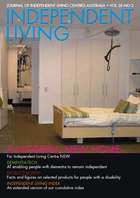
August 2012 - Volume 28, Issue 2
Independent Living Centre NSW (ILC NSW) moves to a new location and takes the opportunity to evaluate factors affecting Choice and Suitability of spaces.
The ILCNSW is 30 years old. During this time the organisation has always been co-located. Many will remember our original home at the Ryde Rroyal Rehabilitation Centre, and of course, more recently in the facility of Northcott Disability Services.
As the lease in our rooms at Northcott became due we decided to advance our need for an independent site within the community, suitable for a provider of information and advice. we were supported in developing our new site through funding from the NSW Department of Family and Community Services: Ageing, Disability and Home Care.
The initial aims were to:
1. Be situated visibly within the community
2. Be easily accessible, including parking
3. have enough space in which to display more assistive technologies, with a capacity to contextualise the display
4. have adequate facilities for staff
After months of looking we settled on a site at the top of Westpoint Shopping Mall, Blacktown, in Sydney's west.
Blacktown is the geographic and demographic heart of Sydney. The site is easily accessible, with more than adequate parking.
During 2011, the Australian Department of Families, Housing, Community Services and Indigenous affairs released the first draft of the Livable housing design Guidelines. Shortly thereafter the then Housing NSW developed draft drawings to those guidelines, producing drawings for one and two bedroomed dwellings at the gold and platinum level of the guidelines.
The ILC NSW was fortunate that the now NSW Land and Housing Corporation gave permission to utilise these drawings in the design of our display. as a result the organisation has been able to build a one bedroomed apartment, at the platinum level, complete and full-sized as an integral component of its display, in which at is displayed in situ or in context of use.
Assistive Technology is any device, system or design, that allowa an individual to perform a task that they would otherwise be unable to do, or to increase the ease and safety with which a task can be performed.
Assistive Technology (AT) can enable the person with dementia to remain independent and safe in their own home for as long as possible. at can also support carers, often family members, who play a very important role in the life of a person living with dementia.
Dementia affects everyone differently, influenced by factors such as previous life experiences, support systems, other
impairments present, as dementia is common in the ageing population, or the specific type of dementia itself.
Involving the person with dementia in the choice of at is paramount to acceptance and success. It is also important to point out that not all AT is going to assist everyone.
Dementia is a progressive disease that involves the decline of brain function. As the disease progresses individuals have
difficulty with memory, problem solving and the ability to learn new things, so introducing at as early as possible seems
to be most beneficial. Reassessment is constantly required to ensure at is effective and useful to the individual at
each stage.
Index of articles from Volume 23 to 27 inclusive.
Copyright © 2009-2013 Independent Living Centre NSW.
Site designed by the Human-Computer Interaction Laboratory, School of Computer Science and Engineering, University of New South Wales.