

 subscribers
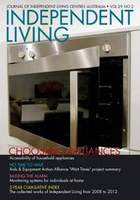
July 2013 - Volume 29, Issue 2
Index of published articles from Volume 24 to 28 inclusive.
Of the domestic appliances found in almost every home, there are a great many choices on the market when looking at style, operation and additional functionality.
This article explores the more common household appliances with an eye for accessibility. Important factors influencing accessibility are universal design and principles of human scale such as anthropometrics and ergonomics.
Accessibility often incorporates characteristics such as dimensions, layout of features and contrast which impact upon areas such as proximity, visual access and clarity of functions. As always, different aspects of accessibility will vary in significance depending on individual factors of the person in question. This article aims to explore different elements of accessibility when considering more common kitchen, laundry and entertainment appliances.
Advances in technology, the ageing population and limited human resources are some of the factors impacting and changing the delivery of healthcare services.
This article aims to explain the major types of monitoring system at home for individuals with special care requirements, considerations for use, possible social impacts and challenges are discussed.
The Aids and Equipment Action Alliance (AEAA) are an active group of AT stakeholders who have been working towards better provision of AT for Victorians since 2006 (aeaa.org.au). Victoria’s State Trustees funded the AEAA to investigate policy options around wait times, with a view to constructively exploring alternatives to meet the needs of people waiting, at times for years, for AT. The AEAA reviewed the policy and economic literature, as well as interviewing and surveying a range of stakeholders.
This article documented the findings from the survey, outlining the impact of waiting for AT, plus a personal perspective of the impact of the 'Wait-time' in Victoria.
Copyright © 2009-2025 Independent Living Centre NSW.
Site originally designed by the Human-Computer Interaction Laboratory, School of Computer Science and Engineering, University of New South Wales.